Showing posts with label playstation 2. Show all posts

Wednesday, May 7, 2014

GTA3 TONIGHT


I beat Vice City this morning (after 11 years) but did I slow down? Hell no, I loaded up Grand Theft Auto 3 in glorious 1440x900 resolution and spread out my Playstation 2 maps. This was the third game I bought for my PS2, and to be able to play it in HD with a mouse is amazing.

You know the drill; I'm streaming GTA3 tonight and if you want to check it out come to www.twitch.tv/Robot2600

Twitch is awesome. You are awesome.

Saturday, January 8, 2011

"Shooting Down": The History of the 1942/194X Arcade Shumps


1942 spawned a series of Capcom shooters, but the original 1984 classic remains my favorite. If you're interested in the history of the 194x series and the cluster of related games, you're on the right blog.

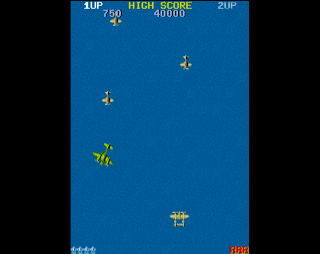
You pilot a p-38 Lightning, the primary American fighter (alongside the P-51 Mustang) in the Pacific Theater. All of these planes would be outdated in about 7 years thanks to jet engines. Your enemy? The entire Japanese Air Force. Like most shooters, expect to die a lot before winning the war.


The game was ported to almost every system available at the time (and Capcom has a web-based version that is free to play, but the website is unstable in my experience). The NES saw a fantastic port which most people growing up in the 80s and 90s will remember. Every video rental store had 1942 or 1943, and the machines were common place fillers in arcades. If one were recreating an arcade today, 1942 would demand a spot.

It's easy to see why: the graphics and simple and clear, the controls are smoother than the other popular vertical shooters (Galaga and Xevious especially) and the game allows 3 shots on the screen. It is a small, but subtle, difference which drastically increases the excitement of the game. 1942 is anything but clunky.

Your fighter can power up with stronger machine guns, or two smaller fighters can join you and fight alongside your wings. Pressing the 2nd button will perform a loop-de-loop, rendering your plane invincible for a few precious seconds. These "loops" can be saved in exchange for points at the end of each level.

The game has 32 levels; it's a sprawling epic across the Pacific, so don't expect to finish this game in 20 minutes. You can continue, but you, thankfully, forfeit your score.


Capcom released the game in their XBOX/PS2 collection, and you can download and play it on your Wii. As long as you are Japanese. North American and PAL gamers will have to check the blogosphere every Monday morning this year in hopes of downloading the classic before anyone else. 1942 will be available for the Virtual Arcade, but the price remains unknown. Considering the game was packaged with many other games recently, I'm hoping for a 500 point download.


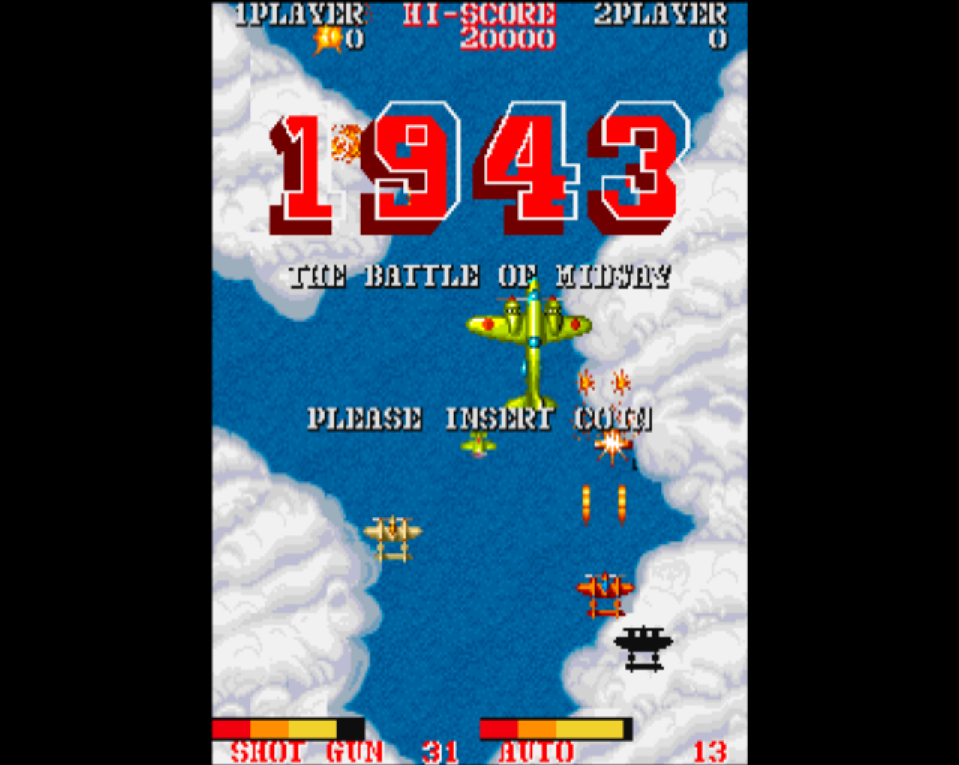
Unfortunately, the music sounds like someone forced to blow on a whistle a gunpoint. Bring your own soundtrack to this one. The "music" certainly is different, however, the series would soon become know for extremely epic tunes, most notably, the 1989 follow-up, 1943: The Battle of Midway. The sequel introduces some questionable mechanics (making the player attempt boss levels twice if they fail), Capcom preserves most of what was fun in the original and introduces other, positive elements (such as a health bar). The NES ports were both very faithful to the arcade in spirit. An "updated" version entitled "1943 Kai" was also released in Japanese arcades, supposedly the game "improves" the weapons, yet most enthusiast seem to dislike the upgrade for whatever reasons.


Then it starts to get crazy. Capcom releases 1941: Counter Attack the next year for arcades, allowing players to choose between different planes. It would later be released on Capcom Collections VOl. 2, and several PSP collections. Interestingly, this game created the convention of adding 1 point to the player's score upon using a continue.

19XX: The War Against Destiny, released five years later in 1995, would cash-in on the 1990s obsession with World War 3, and have the pilot stop a nuclear holocaust. Really this means the same game except with lasers.

Strikers 1945 might seem like it belongs in the series, but it was created by a totally unrelated company, Psikyo. It spawned its own sequels, but they never made it to America. It launched the same year as 19XX, except it showed the (5 sexy female and one male) pilots topless during the ending if the player earned Gold Medals on every stage. This was removed from the American release, but I've included (yes I have) a picture. The game was ported to the Saturn, Playstation, and Playstation 2.


Recently, 1942: Joint Strike appeared on the Xbox 360, and I know a few people who've purchased it (consequently I've logged some hours). It's great fun, to be sure, and a must-have for any fan of the series (or shmups). Supposedly it's a "remake" of the original, but it's more in the tradition of later bullet-hell shooters than the original 1942.


Finally, 1944: The Loop Master rounds out the list as perhaps the least-known title in the series. It's unfortunate, because 1944 proves its worth as one of the 194X series' shining stars. 16 Stages feels right, and the environments are extremely interesting to observe. Perversely, the game uses a horizontal orientation, very rare for vertical shooters. I distinctly remember playing this cabinet in a CiCi's Pizza around 2000~2001, but it has never been released for home consoles. It features as many powerups as one could want, plus simultaneous co-op. Time to fire up MAME32.

The 194X series has proven to be one of the longest-running shooter series in history. Although no new games were released between 2000 and 2007, Capcom has never exploited the series as much as, say, Street Fighter. Every game holds its weight when compared to the others, and because the games now come out so infrequently, they have provided gamers with exciting, intermittent adventures for 26 years. The games are so popular that they spawned imitators. 1945 Strikers maintains the formula very well, and it deserves to be associated with the other 194X games.


These games existed alongside the Raiden series to form the core of vertical scrolling arcade shooters. No doubt the two series cross pollinated, and clearly it is better to examine the 194X games not only in terms of their own series, but the genre as a whole. Except for 1942, all games feature great music, controls, character design, and challenge. Capcom should consider a spin-off F-14 198X series, but keep the toned-down balance that make 1942 and 1943 so classic. It would be a hit.

Like I said earlier, I'm really looking forward to the virtual arcade release of 1942, and I hope it generates a little Internet discussion about these great and influential games. I'd love to hear from any readers who grew up playing these games, or who have recently discovered them because of the Internet. 8bitcity will now, of course, post any breaking news on this series forever into the future. Fans would definitely have enjoyed the NES ports of 1942 and 1943 back in 2005, but I understand if Capcom doesn't want to publish the inferior versions of the games when they can release the arcade version in ports and via the same downloadable services. Whatever the platform, I hope Capcom continues to make a 194X game every few years.


Thursday, June 12, 2008

REZ: Truly Sublime

Humanity has completely linked itself with the computer system known as K-Project, controlled by a massive AI known as Eden. In a philosophical identity crisis, the computer decides to commit suicide and shut itself down. It's up to you, the computer hacker, to travel inside the computer system, destroy all viruses and firewalls, and Rez the system back online. You are armed with anti-virus software, to be delivered upon (in laser form) the virtual avatars of sentient computer programs. They've got plenty of computer-crashing missiles of their own. And lasers. And an almost endless supply of computer code with which to attack. Luckily, you also have the ability to analyze packets of code, unlocking the virtual K-Project. You can absorb powerups and transform your avatar to higher levels, with faster (blazing) lazers.


Rez was an obscure Dreamcast title for a few years. Thankfully, Sega decided to release this badboy for the PS2 when the DC tanked. It was designed by Tetsuya Mizuguchi, who is one of the best game designers working today. He's the brainchild of Meteos and Lumines, both of which share lots of qualities with Rez. Recently, the game was re-re-released for XBoxLive Arcade in the form of Rez HD, sporting high def graphics. I've played the Xbox Version, and found it faithful to the original, but I was playing on an SDTV and can't comment on the HD graphics.


What makes Res so special? For starters, all of your actions are part of the music. Attacking is timed with the beat, and the entire experience is, as the box advertises, synaesthetic. When I say Rez is sublime, you will believe me. You can choose how the music unfolds, but you have to balance your desire for a beat with your desire to score points. Tapping the attack button furiously will produce fast-paced percussions, while using the combo system will create organic samples.


I found the game at a local EBGames for 40 dollars, used. Normally I hate EBGames bullshit prices, especially on used games (which used to be about half of the new price until they flooded the market with used games), but I had seen a friend play Rez. I remember seeing his character race through electronic cities blasting angels and insects, and knew that I had to buy this game. Price gouging aside, Rez is worth every penny, and I promise you'll get your money's worth if you happen to come across this rare-ish game.


It sports all the usual features of a Mizuguchi game: swarms of unlockable features, a kickass soundtrack, and trippy visuals. It's a shooter-on-rails, somewhat similar to Star Fox (or that Star Wars sit-down arcade machine, or Panzer Dragoon) in gameplay. In the summer of 2006 I sat in my room for a week (instead of getting a job) and played Rez with the lights out. I still haven't unlocked everything, Rez can be extremely challenging. I have managed to clear 4/5 levels with 100% and have unlocked all of the skins.


The "skins" are new color schemes for the entire game. Punk, psychedelic, ambient, etc. I had a hard time with these unlockables at first, but in the spring of 2007 one day I played through the game 5 or 6 times, each time unlocking a new skin.

Speaking of skin... Rez also boasts one of the strangest gaming peripherals. A vibrator. It is exactly what you think it is. Plug the vibrator into controller slot 2, and you'll have a pulsing rumble 6-times stronger than your typical DualShock 2. Admittedly, Mizuguchi has shown that the "rumble pack" could be placed under your feet to enhance the overall synaesthetic experience. But if that's the case, why did they include a latex "sleeve" for the Trance Vibrator? If you couldn't guess, this was a Japan-only peripheral. If you want the original article on the Trance Vibrator, check out Game Girl Advance's article on the subject(warning, pictures NSFW).

It's almost hard to accurately describe Rez, because it's very different (but eerily similar) comparatively. It is an ancient story, about a single person who destroys armies. We see it a lot in video games, and its been in books dating back thousands of years.


Rez's appeal comes mainly from its scenery and setting. The locations evoke a grand sense of perspective and size. We understand the infinite potential of computer graphics and user interface options. Rez is cool because the technology exists to make this computer system, and playing the game is proof. The game is Rez, so, in a way, everything in the game is real as well. This hyperreality paradox strikes serious tones with technologically inclined individuals (known as "gamers" in this case).

But, hey, its just a video game. And all talk aside its a pretty fun game. Chances are, if you like video games, then Rez is right up your alley. If only the internet were like Rez...

Thursday, March 6, 2008

Odin Sphere

Every few years a game comes along that far surpasses all others. In 1997, that game was Final Fantasy VII, ten years later, we receive Odin Sphere.


Every review of Odin Sphere has focused on it graphics, and with good justification. The artwork is fantastic. Odin Sphere successfully creates a unique art style, and I stress the word art. The characters are designed and drawn with incredible imagination. The artwork is anime, mixed with fantasy, plus a touch of cubism. In addition to the wonderful artwork, are detailed frames of animation. Characters must have hundreds of frames of animation a piece. I still do not think I can capture the amazing visual aesthetics of Odin Sphere in words, it is like trying to describe Picasso's artwork, words will, out of necessity, will never have the same effects as seeing visual art.

The music tends to blend into the background, but by not overpowering the game it adds a lot to the mood. Odin Sphere is a very somber game, at times. The characters are involved in serious business, almost constantly. Upbeat techno, or heavy metal would have spoiled the mood. Instead, Odin Sphere sports some fantastic orchestral compositions, that could have been slightly catchier. While the songs sacrifice a certain memorable quality (memorable as in Chrono Trigger, of Mega Man 2), they are well composed and arranged. Finally, the sound effects and voice acting are perfect. Each character comes to life through the voices of the great cast. The script is extremely long, and Odin Sphere is one of the few games that has voice acting for every single conversation, including NPCs. If a character speaks in Odin Sphere, the player gets to hear their voice.


Most importantly, Odin Sphere has amazing gameplay. Upon first playing, one might be inclined to button-mash. Fortunately, Odin Sphere will punish button smashing hard. The player has a POW meter, which must be refilled from time to time by not attacking. This may seem a bother, but it helps to keep the player in check. Due to elite enemies that do not suffer knockback (it is worth noting that the player also has an ability to become immune from knockback) the player is forced to hit and run. This develops into a great rhythm that rewards dodging attacks. Considering there is only one attack button, this is a welcome addition, as it creates a fairly deep play system using only one attack button. For a 2D action RPG, it offers the right amount of challenge, in part by allowing the player to switch between difficulty settings at will.

One of my personal favorite features, is the ability to play as five different characters, each with a unique playstyle. This concept is central to the way the story is told. The player receives part of the story by playing through the first character's (Gwendolyn, a flying, spear-wielding Valkyrie) book, with gaps in the time line. Upon playing the other books, the gaps begin to fill in, until, eventually, the story is complete and the secrets are revealed. Each character plays an important role, and each character grows and develops, even most of the bad guys (although it is hard to classify most characters as good or bad, rather the game exists in shade of gray based upon perspective) are dynamic, complicated individuals. As an added feature, the story is viewable anytime after watching the scene in-game, including an option to watch a characters story without interruptions in its entirety.


Odin Sphere is not without a few shortcomings. Slowdown can be a disappointment at times, but it never cripples the gameplay completely. It is unfortunate, but it is very tolerable. During long sessions of playing, I would completely ignore the slowdown, and I honestly feel that it does not warrant the reduction of any points from the game's score. I have read reviews that claim the game has frequent loading times, however, this is an entirely unfair assessment. The game takes about 2 or 3 seconds to load a stage, with about 7 seconds to load a level. I will let the reader be the judge as to whether or not those loading times are acceptable. I feel that both criticisms are due to shortcomings in the Playstation 2's processing power, and not in the artistic realization of Odin Sphere.


Odin Sphere is also one of the few games that is conscious of itself as a piece of art participating in a tradition. It references Wagner's opera Der Ring des Nibelungen extensively, as well as allusions to Shakespeare, Norse mythology, Irish mythology, Hebrew mythology, fairy tales, the Bible, and Swan Lake. It blends these elements together, with a healthy amount of new material to create a wonderful pastiche that is completely engrossing. The world of Odin Sphere is entirely convincing, as it resonates with archetypes in a way reminiscent of Star Wars.

Yet for all of its artistic qualities, Odin Sphere is definitely a video game. The stages remind the player that Odin Sphere is a video game, and it is a proclamation that video games are art. The stage-based design is an embracing of tradition within video games. Stages are one of the most common features of video games, and Odin Sphere realizes the addictive quality a stage-based game possesses. Odin Sphere serves as a model to all video games, in the same way that Aristotle, in his Poetics, describes Oedipus Rex as the model for plays. Odin Sphere embraces qualities of the video game, but includes inspirations from other media as well. This is exactly the quality that makes video games so enjoyable, the hybridization of artwork, literature, and music in an interactive format. But Odin Sphere takes this formula to the next level, and proves that video games deserve as much intellectual respect as other forms of art.